
Westchester County Historical Directory Shelves
Westchester does not have one complete county shelf. Its historical city directories are spread among the New York State Library, Yonkers Public Library, New Rochelle Public Library, the Westchester County Historical Society, holding libraries, and archival map collections. Start by matching the community and time period to a documented run. A county business directory, a local city volume, and a reverse-address book can each answer a different part of the same household question. Catalog confirmation matters because the surviving years are irregular and a listed title is not proof that every volume is digitized or available at every location.
| Collection | Years | Where Held | Access |
|---|---|---|---|
| Westchester city directory | 1860/61 | New York State Library | On-site microfiche |
| Curtin's Westchester County Directory | 1871-72; 1873-74 | Holding library to be confirmed | Catalog and shelf verification |
| Turner's New York & Harlem Railroad Directory | 1891-92 | Holding library to be confirmed | Catalog and shelf verification |
| Westchester business directories | 1922-27 | Holding library to be confirmed | Catalog and shelf verification |
| Westchester County Directory | 1931 | Holding library to be confirmed | Catalog and shelf verification |
| Yonkers city directories | 1858-1939, documented groups | Yonkers Public Library | Bound volumes and microfilm, on site |
The New York State Library city-directory inventory is the documented starting point for the 1860/61 Westchester microfiche. It identifies a real early countywide item, not a promise of a complete annual sequence.
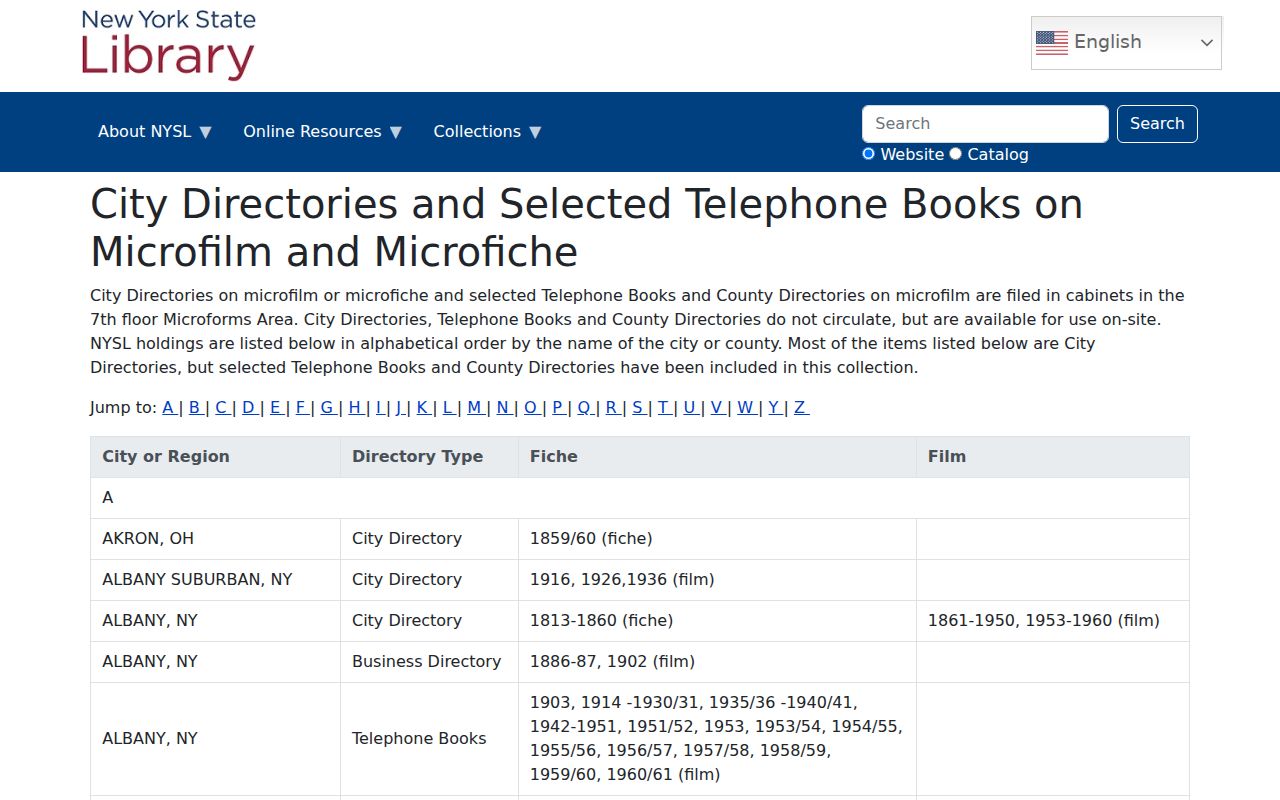
Use the inventory and the holding library's catalog together before making a trip or treating an online search result as a viewable volume.
Westchester County Directory Runs in Yonkers
Yonkers Public Library has the county's most specifically documented local run. Its Local History and Genealogy collection names Yonkers city directories alongside local history books, maps, high-school yearbooks, clippings, and microfilmed Yonkers newspapers at Riverfront Library. That combination makes a city directory entry more useful: an address can be checked against a newspaper notice, a map, or a yearbook without assuming that any one source proves a complete household.
The bound volumes listed by the library are 1858, 1866, 1904-20, 1922, 1924-31, and 1936/39. Its microfilm list includes 1860-61, 1877-78, 1881-82, 1884-95, 1895-1900 reverse-address, 1900-03 reverse-address, 1904-30, 1931, and criss-cross or reverse volumes for 1936 and 1939. These are documented collection groups, not a claim that every intermediate year survives.
Yonkers Public Library's local-history page shows the collection context for these historical city directories.
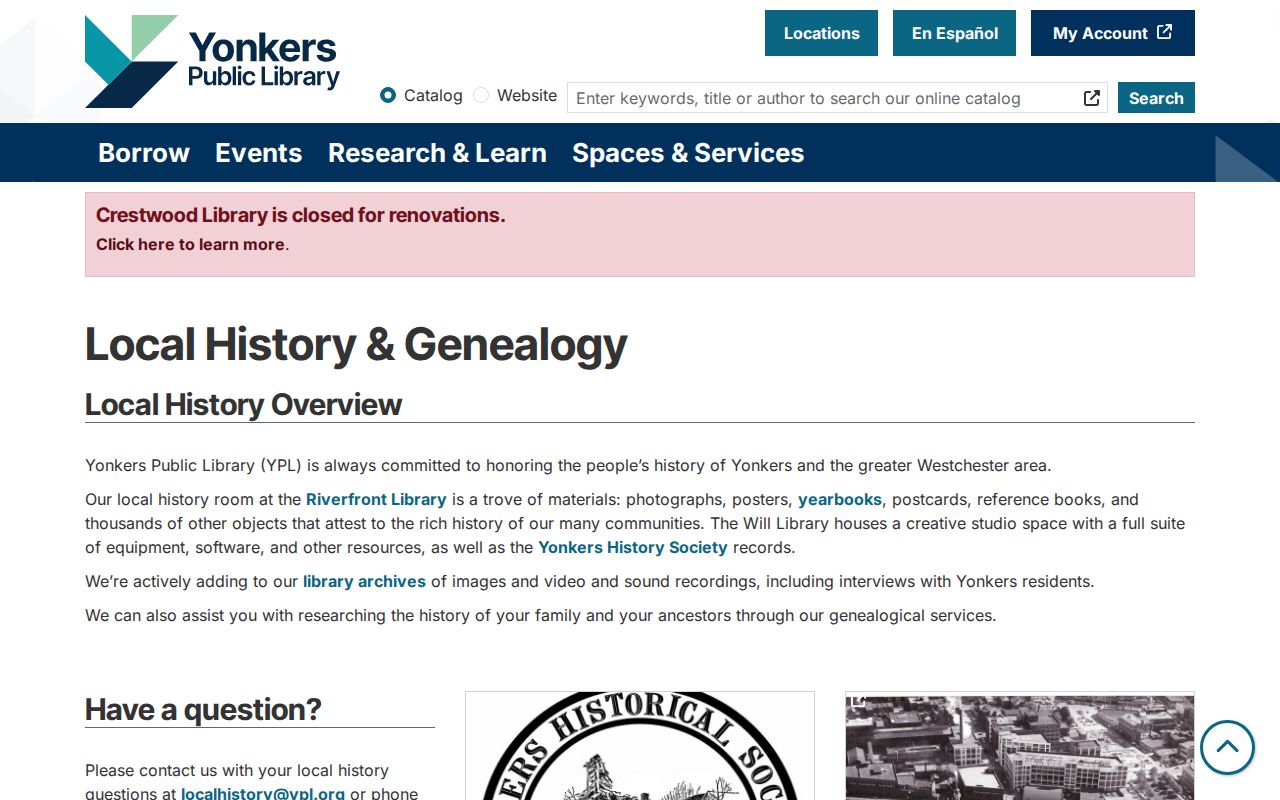
The library record supports an on-site directory route for Yonkers, while the individual volume still supplies the actual spelling, page, abbreviation key, and street arrangement.
- 1858 and 1866: bound Yonkers city-directory volumes listed by the library.
- 1860-61, 1877-78, 1881-82, and 1884-95: documented Yonkers microfilm intervals.
- 1904 through 1931: bound and microfilm holdings overlap in parts of this period, with the gaps shown in the library's own list.
- 1936 and 1939: criss-cross or reverse editions are specifically documented, as are bound 1936/39 volumes.
Note: A reverse-address volume is useful only after its title page and section headings confirm how that edition arranged the street entries.
New Rochelle Historical Directory Series
New Rochelle offers a second, well-described city-directory path. The Public Library's local-history inventory lists Turner's New Rochelle, Larchmont, Pelham, and Mamaroneck directories for 1901, 1904, and 1906-11. It then lists Richmond directories for 1912-20, 1922, and 1924-28. Polk New Rochelle volumes begin with 1925-26 and continue through 1966 with listed gaps. The inventory also identifies a 1911 Sanborn map and 1929-31 Hopkins maps, which can help interpret a street or lot named in a directory.
Those publisher names and dates should be retained as search terms when asking a librarian for a shelf, reel, or catalog record. The sources describe holdings, not an uninterrupted publication history. A name that vanishes between two surviving books creates a date window. It does not, on its own, show whether a person moved, died, changed a listing style, or simply was omitted.
Reading Westchester County Directory Entries
No individual Westchester directory entry was available for inspection during the research. That gap matters. Do not assign a fixed meaning to a letter, mark, or layout across all Westchester city directories. Open the title page and abbreviation key in the specific volume first, then record the wording as printed. An alphabetical list and a reverse or criss-cross street section may use different conventions even in the same edition.
| Name as printed | Transcribe spelling, initials, and order exactly as the volume gives them. |
|---|---|
| Household notation | Record any spouse or widow notation only when the entry prints it. |
| Occupation line | Capture any occupational or business wording without expanding abbreviations by guesswork. |
| Street or residence | Copy the house number and street, then compare it with the directory's own street section when present. |
| Marks and symbols | Use the edition's abbreviation key to interpret any owner, renter, telephone, or other mark. |
- Criss-cross directory
- When a volume includes one, it arranges entries by street or address rather than by surname.
- Householder index
- When present, this is the part of a volume that indexes household names in the arrangement chosen by that publisher.
- Abbreviation key
- The title-page or front-matter key that explains the edition's shortened words and symbols. Check it before interpreting an entry.
The safest inventory is modest: name, notation, address, and the page or image reference. The listed person may be an adult associated with an address, not proof of every person who lived there. Directory evidence becomes stronger when a census release, recorded deed, obituary notice, or map supplies matching time and place.
Westchester County Directory Address Paths
Reverse and criss-cross volumes are especially valuable when an old address comes before a name. In the Yonkers holdings, the documented 1895-1900 and 1900-03 reverse-address microfilm runs, followed by 1936 and 1939 criss-cross or reverse volumes, provide real periods in which the street can be the first key. Check the book's instructions before assuming that every address or apartment appears. The arrangement may be by block, number, street, household head, or a publisher-specific convention.
For a modern parcel question, use the address route on the Westchester County street directory before trying to force a historical directory to answer a current-record question. The two paths meet only after the researcher has tested the historic street name, number, lot context, and date window.
Westchester County Directory Atlases
Maps help when a directory provides a street but no clear modern equivalent. The County Clerk's Historical Maps collection samples more than 30,000 filed maps dating from 1774 to the present, with digitized examples roughly 1793-1928. The county's digitized atlas runs include 1867, 1881, 1901, 1910-11, and 1929-31. The G. M. Hopkins atlas collection has four volumes with town, street, and subdivision indexes.
This is a local comparison that can save a false match. A map may show lots, streets, landmarks, businesses, or owner labels. It does not prove that a named household occupied a particular building. Pair the atlas sheet with the directory volume, then test the lot or street clue against a deed, census release, or municipal record.
Tracing Westchester County Households
A household trail works best as a dated sequence. Begin with the nearest documented city directory, note the name exactly as printed, and then work to the next available volume rather than inventing missing years. Compare street addresses and notation. Pair the resulting time window with the decennial federal census, which is public after 72 years, and then use deeds, mortgages, a newspaper notice, probate, or an atlas when two people share the same name.
- Find the first available city-directory entry that fits the community and surname.
- Move through the next documented directory years, preserving page references and address changes.
- Read a reverse or criss-cross section only if that edition has one and its key supports the interpretation.
- Place each directory interval beside the matching released federal census and a map or deed date.
- Use cemetery, obituary, probate, or church material as a separate historic lead where the collections support it.
A disappearance is not a conclusion. It may reflect a move, death, alternate spelling, changed listing practice, or an omission. The County Archives lists grantor/grantee deeds from 1680-1907, estates from 1782-1909, and an online Surrogate index from 1775-1941, giving several records that can test the interval without turning a directory gap into a claim.
Westchester County Research Desk
When no online image answers the question, the County Archives and WCHS provide the main fallback. Their shared research location is 2199 Saw Mill River Road in Elmsford. WCHS normally lists Reading Room access on Wednesday from 9:30 to 3:30 and office hours Monday through Thursday from 9 to 4:30. Its posted access notice announced a temporary Reading Room closure beginning August 1, 2025. Before travel, email archivesreferencedesk@westchestercountyny.gov for Archives access or info@westchesterhistory.com for WCHS holdings.
WCHS holds more than a directory shelf: published family histories, cemetery volumes, church records, census material, local-newspaper marriage and death compilations, and genealogy files can help test a directory lead. Its collection database has more than 90,000 photo records and 14,000 library records, plus finding aids for nearly 150 special collections, but it is not a complete online catalog. WCHS offers paid remote research at $40 per hour with a one-hour minimum, or $36 for members. Unindexed federal census, orphanage, almshouse, and church work is $50 per hour, or $45 for members.
Note: Contact the archives or historical society before travel because a temporary closure notice and collection access rules can change.
Westchester County Directory Limits
City directories are a historical research layer, not a universal record of residents. Westchester has 43 municipalities and several local holding systems, so a postal place name or one city volume cannot stand in for the whole county. Use directory pages for a name-and-address lead, then verify the needed fact with the appropriate custodian or a record created near the same date. That approach respects both the depth of the shelf and the real gaps between surviving volumes.